
Potential Financial Steps for Tech Professionals in April 2026
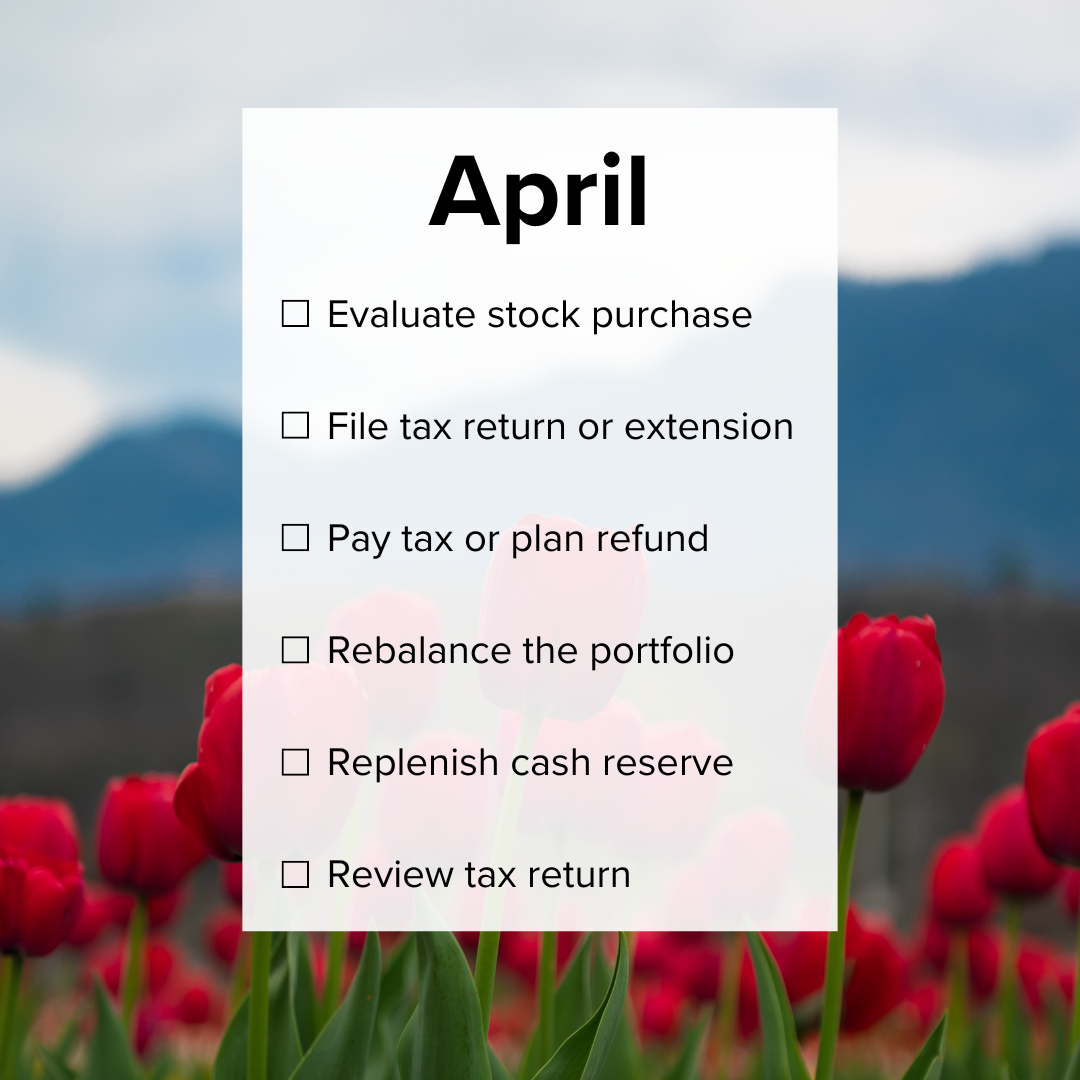
In Bloom
We survived the March snowstorm here in the Pacific Northwest.
Now, it’s lovely!
Potential Steps This Month
Tech professionals take the following financial steps in April:
Evaluate stock purchase
File tax return or extension
Pay tax or plan refund
Rebalance the portfolio
Replenish cash reserve
Review tax return
1. Evaluate Stock Purchase
Although the market’s been down, employees who participated in an Employee Stock Purchase Plan may still come out ahead.
ESPP Purchase
Consider a stock that closed at about:
$239 on 9/30/2025 and
$210 on 3/31/2026.
A six-month lookback might take the lower of the price at the beginning and end of six months and then apply a 15% discount.
15% off $210 is a purchase price of about $179.
The shares may earn a quick gain of over 17%:
gain of $31 ($210 less $179)
divided by $179 purchase price.
For more, check out: How Does an ESPP Work?

Employer Risk
We have a lot riding on our employers:
income,
retirement contributions,
insurance,
benefits…
Maybe even a:
home,
rental, or
small business.
Risk and Return
We love our employers. That’s why we work there!
However, on average - they’re average.
One company has more risk because of single stock exposure. There’s a chance something bad happens to just that business:
a competitor enters the space,
an executive makes a poor strategic decision,
someone cooks the books, etc.
I feel owning a single stock has higher risk with a similar expected return. That’s a bad combo.
Of course, there are other possible outcomes. Volatility is good if the direction’s up!
A good investment can underperform. A bad one can do well.
For more, check out: Is It Worth Holding Employer Stock?

2. File Tax Return or Extension
It’s worth double-checking for opportunities before filing.
There’s Still Time!
Some accounts will accept funds for 2025 until April 15, 2026.
Those include:
traditional IRAs,
Roth IRAs,
Health Savings Accounts (HSAs), and more.
IRA contributions are often overlooked. They’re especially helpful for someone whose employer doesn’t have a retirement plan.
A Spousal IRA contribution may reduce taxable income, depending on:
whether the spouse was covered by a retirement plan at work and
the couple’s income.
The deduction is phased out above income limits for 2025:
$126,000 if covered by a workplace retirement plan and
$236,000 if not covered by a workplace retirement plan.

Running Out of Time
The regular deadline to file personal taxes is April 15, 2026.
May businesses had a deadline of March 15 to give investors time to add the income to their personal returns.
A personal extension filed by April 15th pushes the filing deadline to October 15th. However, taxpayers still need to pay estimated taxes by April 15th to avoid interest and penalties.
3. Pay Tax or Plan Refund
In a perfect world, a taxpayer would neither owe a payment nor receive a refund. However, that rarely happens.
Bad Extremes
It’s usually not ideal to either:
owe a sizable tax payment or
receive a big refund.
A large payment is hard emotionally and on the pocketbook. Underpayment can bring interest and penalties.
A big refund is also a problem. It’s an interest-free loan to the government!
How to Pay the Tax
Consider the best way to pay:
dip into cash reserves,
go on a payment plan,
sell an investment, etc.
Selling an asset may drive up taxes for 2026!
If a household usually pays when filing, it could make sense to:
make quarterly estimated payments,
adjust W-4 withholdings, or
both.
What to Do with a Refund
Some refund options include:
build up a cash reserve,
pay down high interest debt,
increase deductibles,
pay in advance for a discount, and more.
Will the money be needed soon or can it be invested? Remember that it could take weeks for the refund to arrive.
Cash flow planning is especially important for tech professionals flush with cash after receiving their:
annual bonus,
merit increase,
Restricted Stock Unit (RSU) vests, and
Employee Stock Purchase Plan (ESPP) shares.
How to Invest a Refund
Investment options include:
401(k) up to the company match or contribution limit,
Employee Stock Purchase Plan (ESPP),
traditional or Roth IRA,
Health Savings Account (HSA),
taxable brokerage account,
small business,
real estate, and more.
For more on saving and investing, check out:
Your Last Career Will Be Investor
Own Stock or Contribute to ESPP?
Real Estate
Passive real estate losses may not lower taxes until the investment is sold.
Feeding a property cash every month can be particularly painful if:
income drops,
property values fall, or
both.
Check out: Investing in or Betting on Real Estate?

4. Rebalance the Portfolio
A tech professional may have just received:
a bonus,
stock from Restricted Stock Unit (RSU) vests, and
shares through an Employee Stock Purchase Plan (ESPP).
In addition, the stock market has fallen recently. The S&P 500 index is down about 5% year to date.
Lower stock prices can make a portfolio more conservative. It’s important to check the allocation.
Dividends can be reinvested - often automatically.
Interest from high-yield savings and money market accounts can also add cash. Investing the funds may improve returns.
For more considerations, check out:

5. Replenish Cash Reserve
Now’s a great time to check on the emergency and opportunity fund.
Recurring Expenses
I generally suggest someone keep about three (3) to six (6) months of living expenses in cash or cash equivalents.
Factors that could push up the target include:
a single income,
variable compensation,
real estate, and
job uncertainty.
Major Purchases
It’s important to plan for upcoming expenses like:
summer vacations and camps,
home improvements,
vehicle purchases,
new business ventures, and
real estate investments.
I don’t feel stocks, bonds, vehicles, real estate, and cryptocurrencies count toward the cash reserve. Although they may be sold quickly, the market can move faster.
High-yield savings and money market funds might pay 4%, which is:
$400 a year on $10,000,
$2,000 a year on $50,000, or
$4,000 a year on $100,000.
However, it’s important to keep some in checking for ongoing expenses. Paying bills on time can avoid late fees, penalties, and credit score hits.
For more, check out: Is Your Cash Starving?

6. Review Tax Return
It can help to review a tax return with a professional. Tax preparers typically have more time after April 15th.
Here are some questions to ask:
What were my marginal and effective tax rates?
What helped lower my taxes?
Do you see any missed opportunities?
How can I minimize my lifetime taxes?
For more, check out:

Hey, thanks for reading my post on steps for tech professionals in April.
Just a reminder, I share a lot of resources that can help you.
Join the newsletter and get the white paper:
Personal Finance for Tech Professionals
Disclaimer
In addition to the usual disclaimers, neither this post nor these images include any financial, tax, insurance, or legal advice.